There are several factors humans contribute to for a sixth extinction. Probably one of the most heated one (pun intended) is our cause for the world's global warming. The environment has been going for the worse due to our industrializing of many parts of the globe, ousting needed plantation. This leads to the death of many animals that heavily depends on the plants. Due to the lack of very clean ways to dispose factory waste properly, other intact areas have been polluted by trash and would still be destroyed nonetheless. If nothing is done to improve our ways of doing things. everything would lead to the extinction of many organisms.
Blog 4: Types of Selection
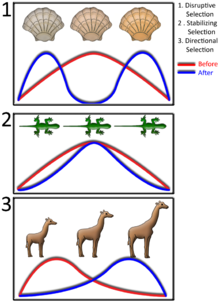
- Directional Selection: This selection is when an uncommon phenotype is chosen over a more common one. It will change the allele frequency by shifting it to another direction, eventually becoming fixed.
- Stabilizing Selection: This selection is when genetic diversity dwindles as population goes stable on a trait value. One of the most common form of natural selection, it mostly leads to negative selection.
- Disruptive Selection: This selection is when extreme values for a trait is chosen over more plain values. Due to varying traits, it'll eventually lead to two distinct groups of the same organism.
Blog 3: Microevolution
Microevolution is a change in the gene frequency, these different alleles are which would be able to lead to a new subspecies. Sometimes it occurs during natural selection where the organisms that have the most suited characteristics in their environment would tend to give offspring with its alleles inherited. Gene mutation, shuffling, and crossing over are among variations of this change.
Blog 2: Fossil Interpreting Difficulties
There are many difficulties before one could fully interpret the fossil. Due to ever-changing weather, no one could really tell where the fossil originates from which kind of environment. The remains could have been moved by forces of nature to another different zone, throwing off its origin. Sedimentation and weathering could both break the fossil.
Subscribe to:
Posts (Atom)