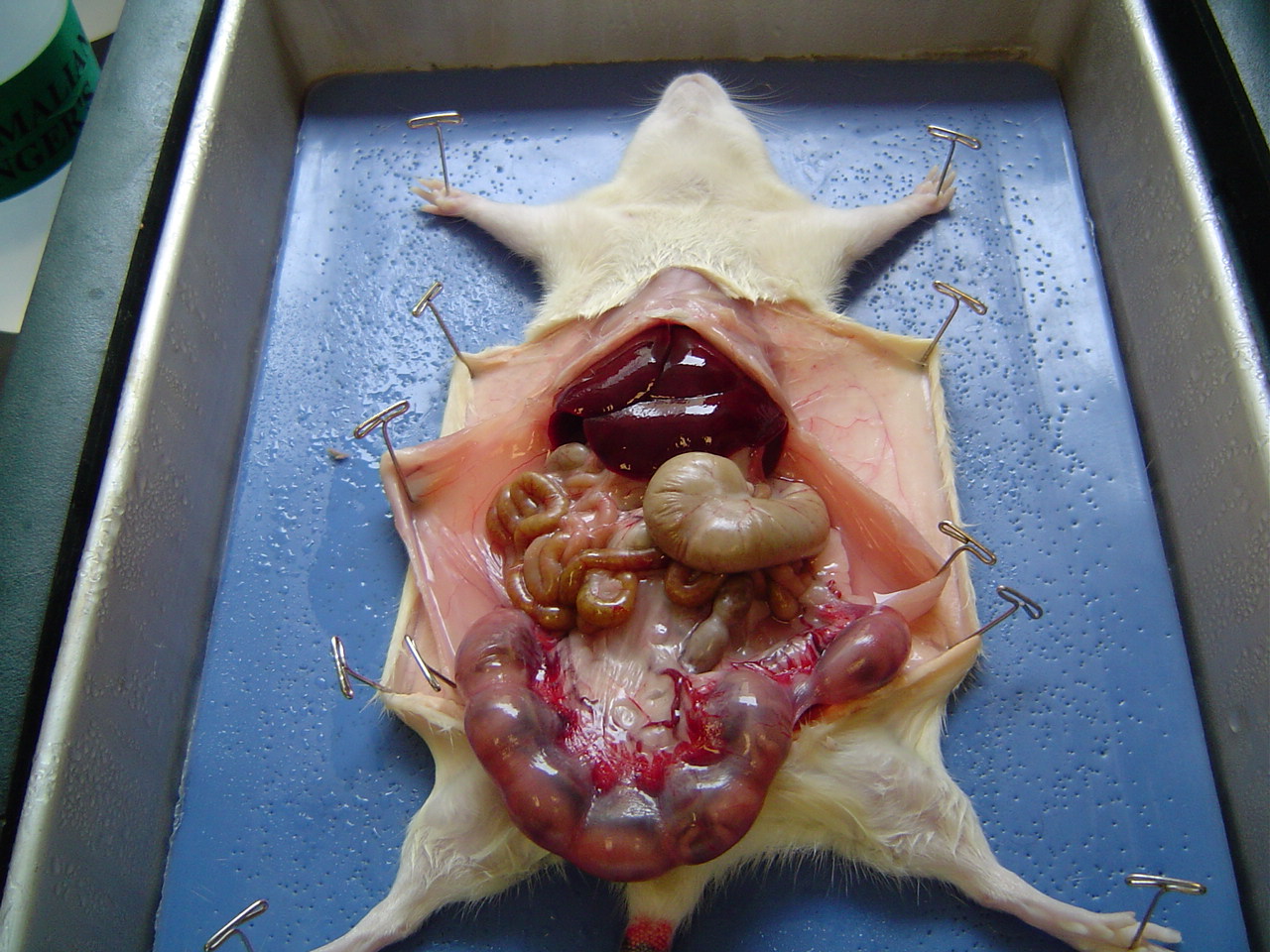
Blog 13: Most Interesting Dissection


By far, the frog dissection we performed was the most interesting among the others. Indeed, it was one of the most "developed" organism we have opened up so far, with an obvious presence of a number of developed organ systems. As such, it took quite some time for me and my partner (and the rest of my table, for that matter) to get to many of the assigned parts, due to the layers and layers of skin, bones, muscles, and other organs covering up vital parts. No doubt that it was the most complex yet fascinating dissections I have done yet.

Blog 12: Worm Dissection


First off, I was surprised already that we were going to dissect a worm in the first place. Being one of the first dissections I have done on an entire organism, I'm surprised on the internal complexity of these worms. Never have I thought they would have things like multiple hearts. Last, but no least, it was surprising to find out that the other animals that we are going to dissect are bigger and would be more sophisticated, and that even with all these organs, the worm is a "simple" life form.

Blog 11: Alternation of Generations


Plants undergo a life cycle, an alternation of generations. These organisms transition from a diploid phase to a haploid phase. At this time, processes make reproductive cells, which will then turn into a gametophyte. It will then combine with another gamete and its product will soon become a diploid plant.

Blog 10: Dissection

Blog #10
Why is dissection an important part of a biology curriculum? Which animals and/or plants should be included in biological studies?


The discoveries of dissection is crucial to finding out the build of many organisms. It allows students to learn the internal structures and the various systems of animals.  Opening up an animal allows one to learn a wider knowledge of the dissected, which in turn could help in research and future experiments.